
Delivering accurate and reliable answers from AI within complex enterprise data environments has consistently been a challenging task. Especially when it comes to integrating information scattered across various systems or handling in-depth queries that a single search cannot resolve, AI often produced incomplete or inaccurate responses.
To address these challenges, Google has introduced a new approach: 'Agentic RAG (Retrieval Augmented Generation),' which has enhanced enterprise AI accuracy by up to 34%. On June 5, 2026, Google Research and Google Cloud announced the release of this Agentic RAG framework and its integration into the Gemini Enterprise Agent Platform.
Google Boosts Enterprise AI Accuracy by 34%: The Key is the 'Sufficient Context Agent'
Traditional Retrieval Augmented Generation (RAG) systems typically involve a large language model (LLM) performing a single search in an external database to generate an answer. However, for a question like 'What are the server specifications used in Project X?' if the relevant document only contains a server ID and the actual specifications reside in another database, conventional RAG systems would often provide incomplete answers or fail to find the information.
Agentic RAG tackles this problem by adopting a multi-agent architecture where several specialized AI agents collaborate. Among these, the 'Sufficient Context Agent' plays a particularly crucial role.
Before the AI generates an answer, this agent independently reviews whether the retrieved information is sufficient for the query and if any parts are missing. If it determines that the information is insufficient, the AI autonomously creates additional search keywords and repeatedly explores and verifies the necessary information. This functions like an internal 'Quality Assurance (QA) system' built into the AI, effectively reducing 'hallucination,' where the AI invents answers without factual basis.
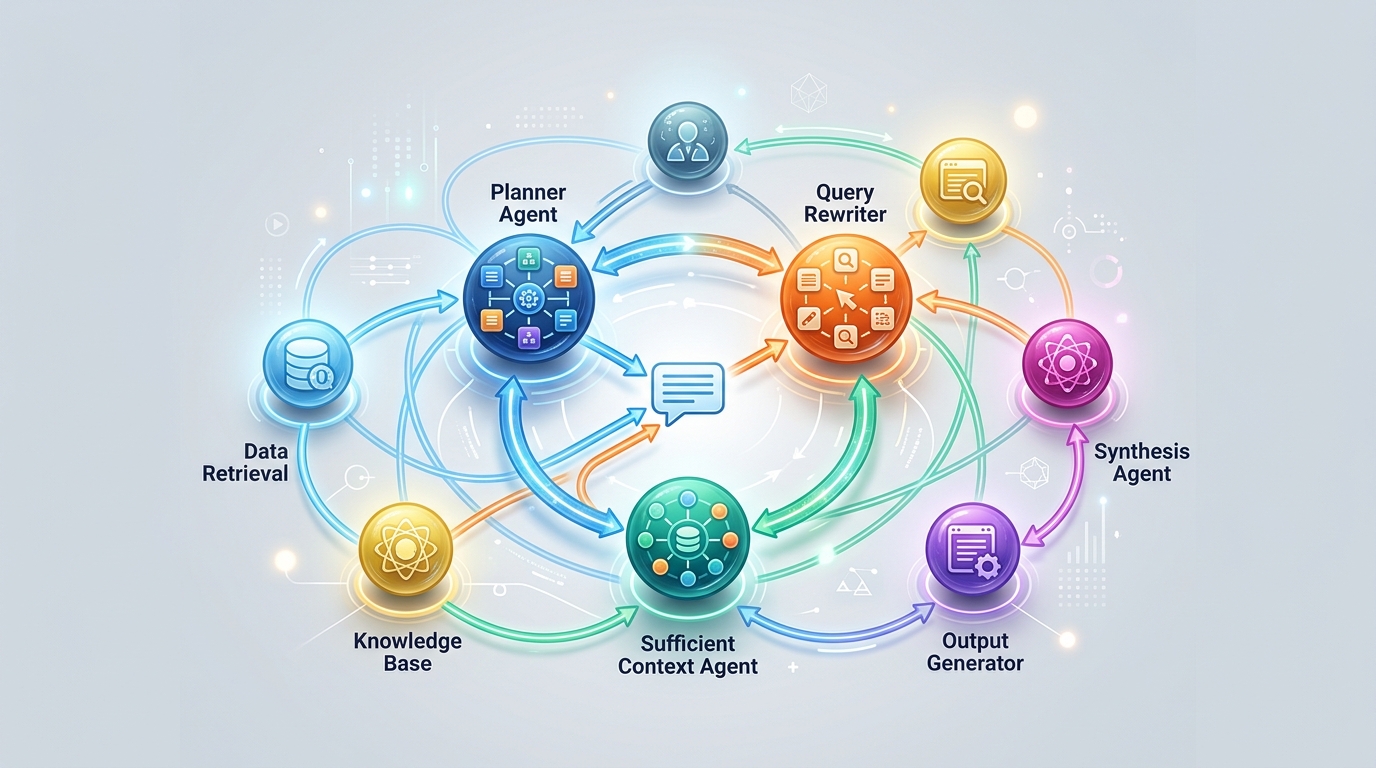
Agentic RAG structure with multiple AI agents collaborating
Solving Complex Queries Through Organic Collaboration of Multiple Agents
Agentic RAG is not just a simple single-agent system. Centered around an Orchestrator that coordinates the entire retrieval process, various agents collaborate organically, including:
- Planner Agent: Establishes a plan for which data sources to query.
- Query Rewriter: Rewrites the user's question into a more specific and searchable format.
- Search Fanout Agent: Gathers information in parallel from diverse data sources.
- RAG Agent: Generates an initial answer based on the retrieved information.
- Sufficient Context Agent: Reviews whether enough information is available for the answer, and if not, instructs further searches.
This multi-agent structure is particularly effective in enterprise environments where information is fragmented across multiple databases or teams. It is deemed highly suitable for enterprise use cases requiring accurate and traceable answers, such as medical records, legal documents, internal knowledge bases, and project data.
What About Actual Performance? 90.1% Accuracy and Low Latency
Google Research's test results demonstrate the robust performance of Agentic RAG. Agentic RAG achieved up to 34% higher accuracy compared to traditional RAG in fact-based question-answering evaluations. Furthermore, in complex 'cross-corpus' settings, which require exploring multiple independent datasets, it achieved an impressive 90.1% accuracy.
Contrary to concerns that increased accuracy might lead to slower response times, Google reported that the difference in response latency was, on average, within 3% compared to a single corpus setup. This suggests that users won't experience noticeable delays for improved reliability, indicating that Agentic RAG is well-balanced for real-world enterprise application.
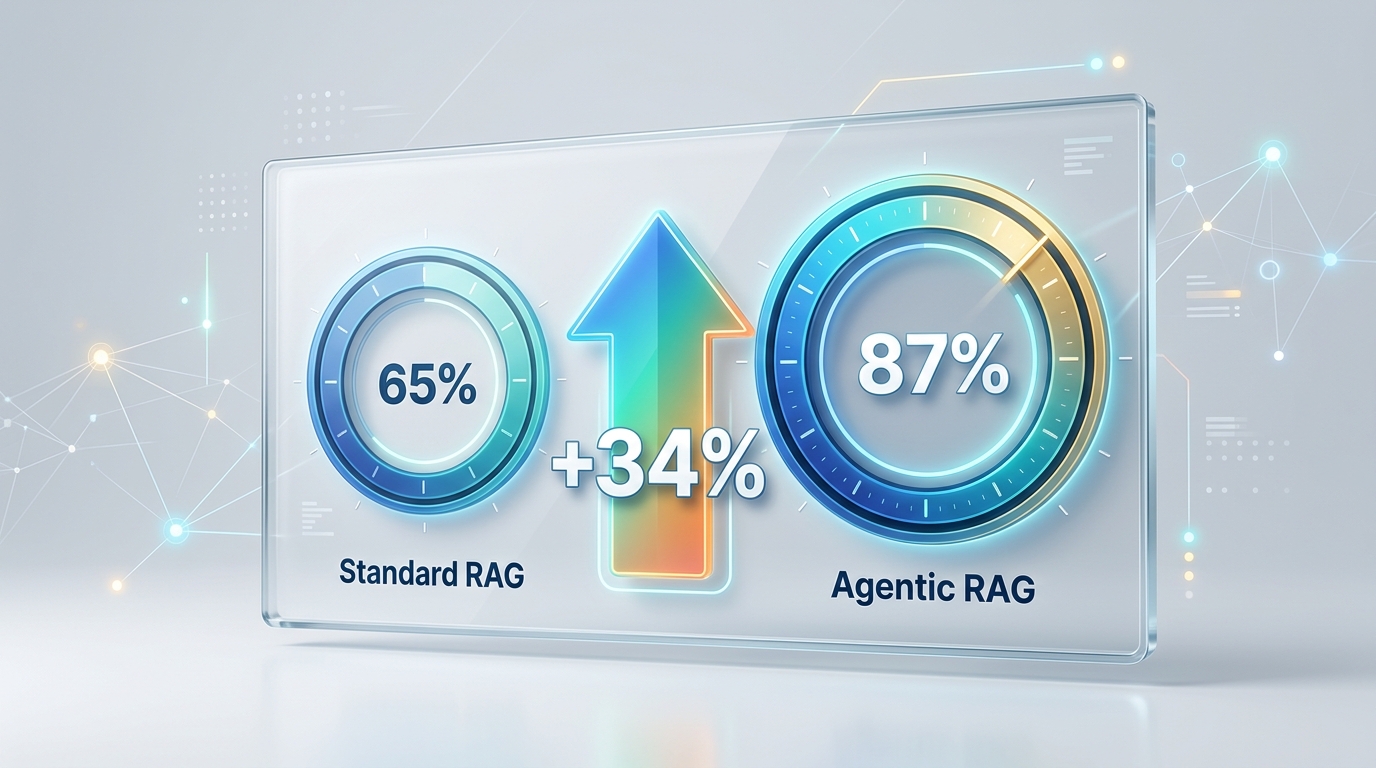
Agentic RAG's 34% improved accuracy
Key Checkpoints for Enterprise Stakeholders Now
Google's Agentic RAG offers several important implications for stakeholders considering enterprise AI adoption:
- Complex Data Environments: If internal data is fragmented across various systems, multi-agent solutions like Agentic RAG can overcome the limitations of traditional RAG.
- High Accuracy Requirements: In fields where accuracy and reliability of answers are absolutely critical, such as healthcare, legal, and finance, the 34% accuracy improvement of Agentic RAG holds significant value.
- Auditability and Traceability: Agentic RAG clearly records the sources of AI responses, enhancing auditability and traceability. This is a crucial advantage for regulatory compliance and internal controls.
- Gemini Enterprise Agent Platform: Currently available in public preview, it is advisable to thoroughly test it within your actual work environment before full deployment.
Frequently Asked Questions
What is the biggest difference between Agentic RAG and traditional RAG?
The biggest difference is that while traditional RAG typically finds information and generates an answer in a single search, Agentic RAG involves multiple AI agents collaborating to analyze the question, review if sufficient information is available, and if not, autonomously perform iterative additional searches. This grants the AI 'persistence' to explore until it secures 'sufficient context.'
Is Agentic RAG essential for all businesses?
It's difficult to conclude that it is essential for all businesses. However, if your enterprise environment has fragmented data, requires complex connections between multiple data sources for queries, and places high importance on the accuracy, reliability, and source traceability of AI responses, then Agentic RAG can be a highly effective solution. For example, it can be particularly useful in industries handling sensitive information such as healthcare, legal, and finance.
Are there any precautions to consider when adopting Agentic RAG?
Agentic RAG has a more complex structure than traditional RAG, which may require more time and resources for initial system setup and integration. Furthermore, coordination and optimization among multiple agents are crucial, and the roles of the agents must be meticulously designed to match the enterprise's specific data environment to expect optimal performance. It is recommended to conduct thorough pilot tests and seek expert assistance before adoption.
Concluding Remarks
Google's Agentic RAG heralds a new era where enterprise AI goes beyond simply finding information, instead exploring and verifying information like a skilled researcher to provide highly reliable answers. The figure of Google enterprise AI accuracy improved by 34% is more than just a performance enhancement; it's a powerful signal that AI can evolve into a more trustworthy partner assisting with critical business decisions. It remains to be seen what transformations this technology will bring to many businesses dealing with complex data.